

What Is The Chemical Makeup Of Quartz
Dwelling house » Minerals » Quartz
Quartz
A ubiquitous mineral with an enormous number of uses
Article by: , PhD, RPG
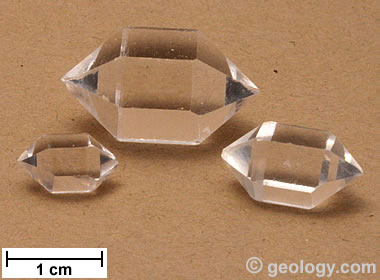
Quartz crystals: Herkimer "Diamond" quartz crystals. A clear, "rock crystal" diverseness of quartz.
Quartz is...
- the most abundant mineral in Earth's crust
- extremely resistant to weathering
- highly resistant to concrete and chemical weathering
- used to make time pieces because it vibrates at a precise frequency
What is Quartz?
Quartz is a chemic compound consisting of one part silicon and two parts oxygen. Information technology is silicon dioxide (SiOtwo). Information technology is the most arable mineral found at World'due south surface, and its unique properties make information technology one of the most useful natural substances.
Where is Quartz Institute?
Quartz is the most abundant and widely distributed mineral found at Earth's surface. It is nowadays and plentiful in all parts of the world. It forms at all temperatures. It is abundant in igneous, metamorphic, and sedimentary rocks. It is highly resistant to both mechanical and chemical weathering. This durability makes it the dominant mineral of mountaintops and the primary elective of beach, river, and desert sand. Quartz is ubiquitous, plentiful and durable. Minable deposits are found throughout the globe.
Pop Quartz Gems
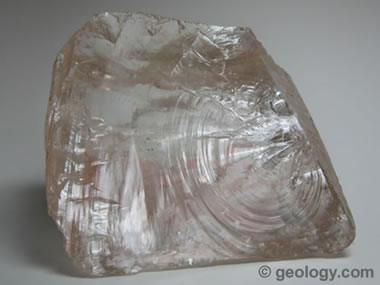
Rock crystal quartz: Transparent "stone crystal" quartz. This specimen shows the conchoidal fracture (fracture that produces curved surfaces) that is feature of the mineral. Specimen is well-nigh four inches (ten centimeters) across and is from Minas Gerais, Brazil.
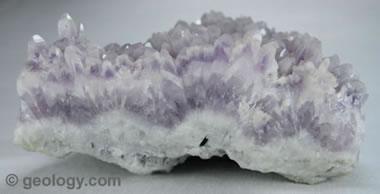
Amethyst quartz: Purple crystalline quartz is known as "amethyst." When transparent and of high quality, information technology is often cut equally a gemstone. This specimen is most iv inches (10 centimeters) across and is from Guanajuato, Mexico.
Physical Properties of Quartz | |
| Chemic Classification | Silicate |
| Color | Quartz occurs in virtually every color. Common colors are clear, white, grey, purple, yellow, dark-brown, black, pink, green, red. |
| Streak | Colorless (harder than the streak plate) |
| Luster | Vitreous |
| Diaphaneity | Transparent to translucent |
| Cleavage | None - typically breaks with a conchoidal fracture |
| Mohs Hardness | 7 |
| Specific Gravity | 2.6 to ii.7 |
| Diagnostic Properties | Conchoidal fracture, burnished luster, hardness |
| Chemic Composition | SiOtwo |
| Crystal Arrangement | Trigonal |
| Uses | Glass making, abrasive, foundry sand, hydraulic fracturing proppant, gemstones |
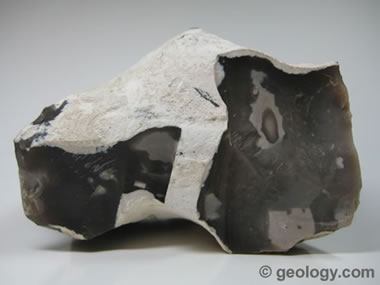
Flintstone: Flint is a variety of microcrystalline or cryptocrystalline quartz. It occurs as nodules and concretionary masses and less oftentimes as a layered eolith. It breaks consistently with a conchoidal fracture and was one of the outset materials used to make tools by early people. They used it to make cutting tools. After thousands of years, people go on to use it. Information technology is before long used as the cutting edge in some of the finest surgical tools. This specimen is well-nigh iv inches (x centimeters) across and is from Dover Cliffs, England.
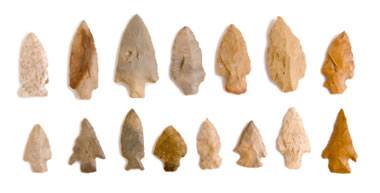
Quartz flint arrowheads: One of the showtime uses of quartz, in the form of flint, was the product of abrupt objects such as knife blades, scrapers, and projectile points such as the arrowheads shown to a higher place. Epitome copyright iStockphoto / Leslie Banks.
What are the Uses for Quartz?
Quartz is i of the most useful natural materials. Its usefulness tin can be linked to its concrete and chemical properties. Information technology has a hardness of seven on the Mohs Scale which makes it very durable. Information technology is chemically inert in contact with near substances. It has electric properties and heat resistance that brand it valuable in electronic products. Its luster, color, and diaphaneity get in useful as a gemstone and also in the making of glass.
Uses of Quartz in Glass Making
Geological processes accept occasionally deposited sands that are composed of well-nigh 100% quartz grains. These deposits have been identified and produced every bit sources of high-purity silica sand. These sands are used in the glassmaking manufacture. Quartz sand is used in the production of container drinking glass, apartment plate drinking glass, specialty glass, and fiberglass.

Quartz glass windows: Glassmaking is one of the primary uses of quartz. Epitome copyright iStockphoto / Chinaface.
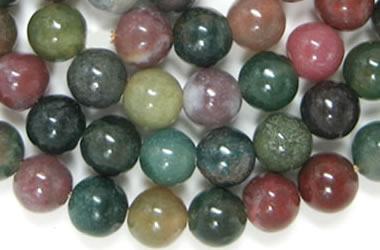
Jasper chaplet: Quartz is often used in jewelry or as a gemstone. These jasper beads are an instance of quartz used as a gemstone.
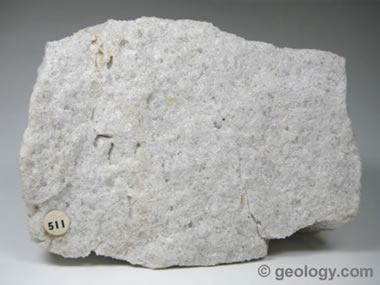
Quartz glass sand: Loftier-purity quartz sandstone suitable for the manufacture of high-quality glass. "Glass sand" is a sandstone that is equanimous nearly entirely of quartz grains. Pictured here is a specimen of the Oriskany Sandstone from Hancock, West Virginia. In a few locations, the Oriskany is over 99% pure quartz. Much of it has been used for container drinking glass, simply some of it has been selected for use in making lenses for the largest telescopes. Specimen is virtually four inches (ten centimeters across).
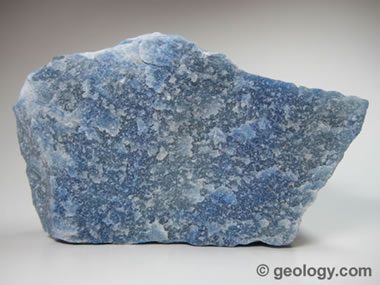
Blue Aventurine Quartz: Aventurine is a colorful multifariousness of quartz that contains abundant shiny inclusions of minerals such as mica or hematite. Information technology is oftentimes cut and polished for use as an ornamental stone. Mutual colors for aventurine are green, orangish, and blueish. This specimen is nearly four inches (ten centimeters) across and is from India.
Uses of Quartz as an Abrasive
The loftier hardness of quartz, vii on the Mohs Calibration, makes it harder than most other natural substances. As such it is an excellent abrasive material. Quartz sands and finely footing silica sand are used for sand blasting, scouring cleansers, grinding media, and grit for sanding and sawing.
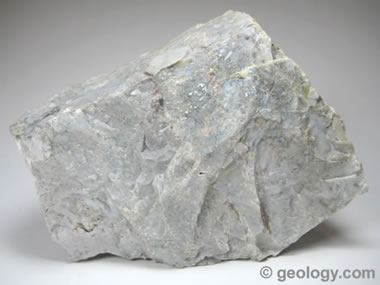
Chert: Chert is a microcrystalline or cryptocrystalline quartz. It occurs equally nodules and concretionary masses and less ofttimes every bit a layered deposit. This specimen is near four inches (x centimeters) across and is from Joplin, Missouri.
Uses of Quartz as a Foundry Sand
Quartz is very resistant to both chemicals and heat. It is therefore oft used as a foundry sand. With a melting temperature college than nigh metals, it can be used for the molds and cores of mutual foundry work. Refractory bricks are ofttimes fabricated of quartz sand because of its high heat resistance. Quartz sand is too used as a flux in the smelting of metals.
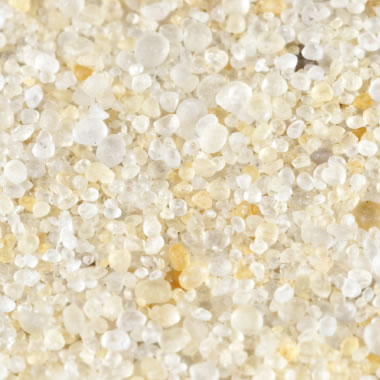
High-Purity Quartz Sand: Did you lot know that quartz is the main ingredient in glass? Geologists locate deposits of sand or sandstone that are composed almost entirely of quartz. Surprisingly, they take found numerous sand deposits that naturally consist of 98% quartz or more! This cloth is mined, processed to remove impurities, and so melted at the glass factory. The sand in a higher place was mined from the St. Peter Sandstone of Wisconsin. Photograph copyright iStockphoto / BanksPhotos.
Uses in the Petroleum Industry
Quartz sand has a high resistance to beingness crushed. In the petroleum industry, sand slurries are forced down oil and gas wells under very high pressures in a procedure known as hydraulic fracturing. This loftier pressure fractures the reservoir rocks, and the sandy slurry injects into the fractures. The durable sand grains concur the fractures open up after the pressure is released. These open fractures facilitate the menstruation of natural gas into the well diameter.
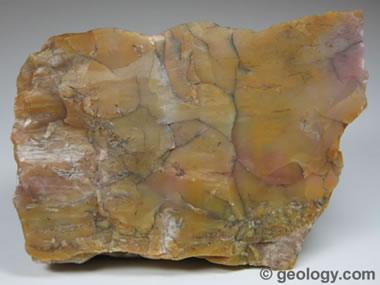
Silicified forest: Silicified "petrified" woods is formed when cached plant debris is infiltrated with mineral-bearing waters which precipitate quartz. This quartz infills the cavities within the woods and often replaces the woody tissues. This specimen is about four inches (ten centimeters) across and is from Yuma County, Arizona.
The best way to acquire about minerals is to report with a drove of pocket-sized specimens that you can handle, examine, and observe their properties. Inexpensive mineral collections are available in the Geology.com Store.
Many Other Quartz Sand Uses
Quartz sand is used as a filler in the manufacture of rubber, pigment, and putty. Screened and done, advisedly sized quartz grains are used as filter media and roofing granules. Quartz sands are used for traction in the railroad and mining industries. These sands are also used in recreation on golf courses, volleyball courts, baseball game fields, children's sand boxes and beaches.
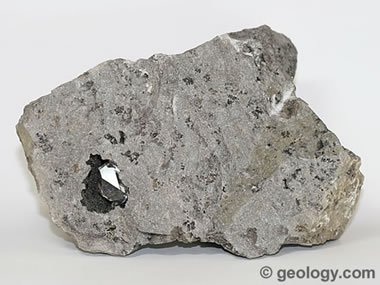
Quartz crystal: A Herkimer "Diamond" quartz crystal in dolostone. This specimen is nigh six inches (15 centimeters) across and is from Middleville, New York.
Uses for Quartz Crystals
Ane of the most astonishing properties of quartz is the ability of its crystals to vibrate at a precise frequencies. These frequencies are then precise that quartz crystals can be used to brand extremely accurate time-keeping instruments and equipment that tin transmit radio and television signals with precise and stable frequencies.
The tiny devices used for these purposes are known as "crystal oscillators." The first crystal oscillators were developed in the 1920s, and but twenty years later, tens of millions of them were needed each year to supply the military during World War Ii. Today, billions of quartz crystals are used to make oscillators for watches, clocks, radios, televisions, electronic games, computers, cell phones, electronic meters, and GPS equipment.
A wide variety of uses have also been adult for optical-grade quartz crystals. They are used to brand specialized lenses, windows and filters used in lasers, microscopes, telescopes, electronic sensors, and scientific instruments. The textile of beach sand is now the material of the earth's almost advanced electronic devices.
A Need for Synthetic Quartz Crystals
During the 1900s the demand for high-quality quartz crystals accelerated so rapidly that mining operations around the world were unable to supply them in adequate quantities. Fortunately, this need was realized during World War Two, and military and private industry began working on methods to grow synthetic quartz crystals to meet the special requirements of optical and electronics apply.
Today, most of the quartz crystals used in electronic components and optical instruments are grown in laboratories instead of produced from mines. Most of the laboratories grow their crystals using methods based upon the geological process of hydrothermal activity. The constructed crystals are grown at loftier temperatures from superheated waters that are rich in dissolved silica. These manufactured crystals tin exist grown in shapes, sizes and colors that match the needs of manufacturing processes. The cost of growing constructed quartz crystals is competitive with mining, and the but limit on product is the availability of crystal growth equipment.
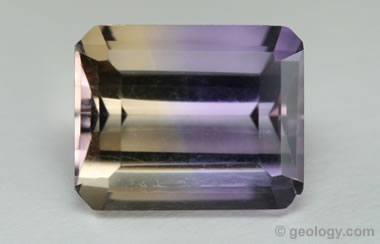
Ametrine: A bicolor stone combining golden citrine and purple amethyst. This gem measures virtually 8x10 mm.
Quartz as a Gemstone
Quartz makes an excellent gemstone. It is hard, durable, and usually accepts a bright polish. Popular varieties of quartz that are widely used as gems include: amethyst, citrine, rose quartz, smoky quartz, and aventurine. Agate and jasper are as well varieties of quartz with a microcrystalline construction.
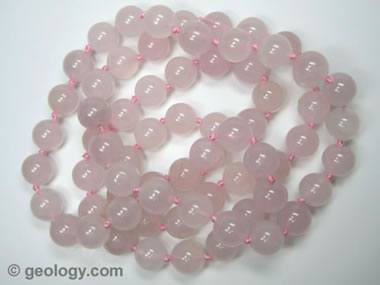
Rose quartz beads: Translucent rose quartz - cut and polished chaplet. Each bead is about ten millimeters in diameter.
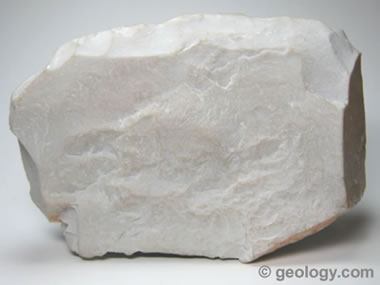
Novaculite is a dumbo, cryptocrystalline variety of quartz with a fine-grained and very uniform texture. As quartz, it has a hardness of 7 (harder than steel) and is used as a "whetstone" for sharpening knives.
Special Silica Stone Uses
"Silica stone" is an industrial term for materials such equally quartzite, novaculite, and other microcrystalline quartz rocks. These are used to produce annoying tools, deburring media, grinding stones, hones, oilstones, stone files, tube-factory liners, and whetstones.
Tripoli
Tripoli is crystalline silica of an extremely fine grain size (less than x micrometers). Commercial tripoli is a nearly pure silica material that is used for a diversity of balmy abrasive purposes which include: soaps, toothpastes, metallic-polishing compounds, jewelry-polishing compounds, and buffing compounds. It can be used every bit a polish when making tumbled stones in a rock tumbler. Tripoli is too used in brake friction products, fillers in enamel, caulking compounds, plastic, paint, rubber, and refractories.
Find Other Topics on Geology.com:
 Rocks: Galleries of igneous, sedimentary and metamorphic rock photos with descriptions. |  Minerals: Information about ore minerals, precious stone materials and stone-forming minerals. |
 Volcanoes: Articles nearly volcanoes, volcanic hazards and eruptions past and present. |  Gemstones: Colorful images and manufactures about diamonds and colored stones. |
 General Geology: Manufactures near geysers, maars, deltas, rifts, common salt domes, h2o, and much more! |  Geology Store: Hammers, field bags, hand lenses, maps, books, hardness picks, gold pans. |
 |  Diamonds: Learn well-nigh the properties of diamond, its many uses, and diamond discoveries. |
Source: https://geology.com/minerals/quartz.shtml
Posted by: calhounfoolity.blogspot.com
0 Response to "What Is The Chemical Makeup Of Quartz"
Post a Comment