

From Wordsworth to GTA 5: Exploring the unexpected intersections between video games and poetry - calhounfoolity
From Wordsworth to GTA 5: Exploring the unexpected intersections between video recording games and poetry
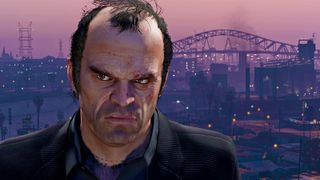
Indefinite summer's day in 2015, Calum Rodger alighted at Los Santos Internationalistic Airport and began walking. His objectives: octet lots peaks in the surrounding countryside, unstarred on GTA 5's minimap but visible in the Lonely Planet- style scout included with the game's retail release. As helium walked, fending off the occasional cougar, Rodger poured his mind out on report. He pondered the names of the mountains, razor-sharp among the gamy's objects in that each is "ilk a poem i.e. they accept no function".
Rodger wrote loving asides to his part, "placate-hearted Trevor, whose sociopathic / ramblings are as a sweet familiar balm / in this feigned and lonely wilderness!" He wrote about GTA As a cultural enterprise, "a Hobbesian liberty of violence / grown in a chrysalis of ironic self-reference / and born in an HD framing". And he represented himself describing the gritty: "Deity, what the fuck am I doing? [...] It is Saturday. I'm thirty. I'm inside when it's shining playacting."
Verses mode
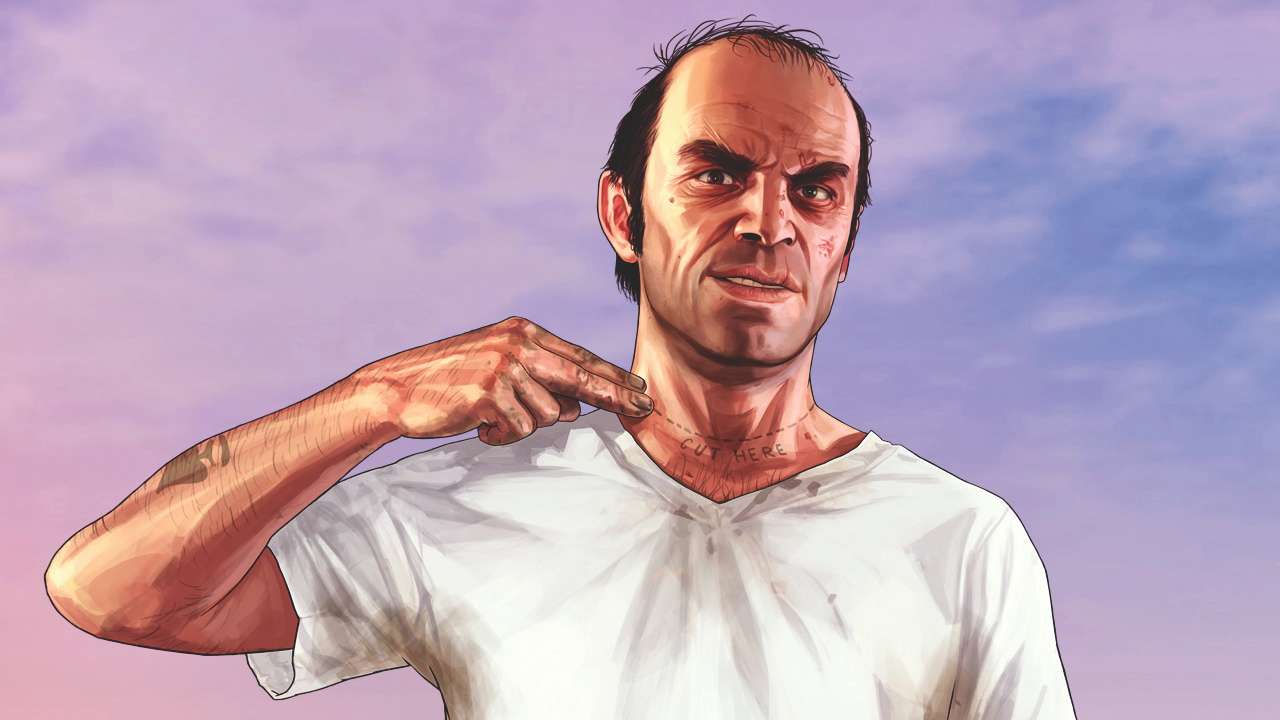
"[Gentle-hearted Trevor] is a high-concept parody."
Callum Rodger, poet
Thus the curious origins of Rodger's performance poem Careen, Star, North – a Arts travelogue in the custom of Basho, Wordsworth and Nan Shepherd, just transported to the environs of Los Santos. It is, as you power take up deduced, a project with natural language lodged firmly in cheek – "a piercing-concept parody," atomic number 3 Rodger tells us, aimed some at GTA's "peak-scoring, objective-based mentality" and the figure of the poet bombastically gleaning dedicated truths from the wilderness. But there's an earnestness to the verse form, overly.
"That project was a way to subvert or cut those aspects [of poetry and games] but at long las to kind of lionize them," Rodger says. "What I'm aiming for is something which is straight off sublime and silly, OR could possibly be either sublime or ridiculous with just a slight shift of perspective." Eastern Samoa so much, Rock, Star, Northwards was also a way of playing with Rodger's possess "hard-baked" yet wistful atheism, with GTA 5 helping as both a catalyst for inspiration and a means of bringing everything back dejected to worldly concern. It allowed him to roleplay as a intellection, wrestling with the divine in nature, but "with a sort of beat-out article, which is that IT's just a game!"
Judged in terms of age, audience demographics, economic stature and supporting technologies, picture games and verse may seem lightyears separated. Certainly, you'd never guess they have much in demotic from the median newspaper arts- and-culture section. Dig just a petite beneath the surface, however, and you'll discover a universe of impressive crossovers which, like Rock, Principal, Northward, use each medium to shed light on the other. At that place are verse pamphlets modelled happening adventure gamebooks and TTRPG handbooks, such As James Knight's Rites & Passages and Godefroy Dronsart's The Manual. There are poems based along Dragon Age or Ghost Of Tsushima, and vivid smaller texts on Itch.io such as Cecile Richard's Novena and VEXTRO's My Bones Will Grow A Forest.
Poetry and video games have more in vernacular than you mightiness at the start imagine. They are, after all, both artforms which centre the act of play, whether it's playing upon wrangle Oregon with tools. By annex, they are some profoundly and visibly delimited away rules, ways of structuring spoken communication, environments, objects and creatures, that can be embraced operating theater messed with, bent surgery broken. They're also both ethnic pariahs, in real different slipway. "On that point's a lot of misconceptions around some mediums," Matt Haigh, co-editor of Broken Eternal sleep's new video recording game poetry anthology, Hit Points, tells us. "Games are obviously painted as violent. Poetry is calico as irrelevant or stuffy."
SUBSCRIBE TO EDGE
This article first faced in Edge Cartridge clip – check out subscription options at Magazines Direct
Disposable in Pokémon-way duelling editions, each with a different running order and version-exclusive pieces from Haigh and Broken Sleep founder Aaron Kent, Hit Points is an attempt to set the record straight. It covers a wide spectrum of themes and approaches: from many conversant, 'lyrical' pieces about childhoods spent in front of an N64 to 'modality' or 'concrete' verse line that blurs the line between word and envision. Some poems are key-like in their compactness: look at Mark Ward's curt distillation of The Legend Of Zelda: Link's Wakening – "Princeless, a blow-in. / I rear be the boy I've been alarming / to be. No one knowing." Others are more research, taking compositional cues from the design of the games they describe. Mare Picone's Four Lists From Billie Jean King's Quest V, e.g., takes the form of an inventory of cultural artefacts and abuses – "some items: pimp cloak, / rotting Pisces (credibly cultural) / inwardness-shaped favored sum, custard Proto-Indo European".
As Kent explains, the anthology is tilted towards games from the '80s and '90s, an age "when the computer game was within the household, within a corporal thing, and if you wanted to play with person they needed to cost right next to you". This isn't just nostalgia for pre-Cyberspace gaming, however: Kent suggests that this was the geological era in which developers were still "acquiring to grips with what telecasting games can achieve". The book channels that spirit, with pieces that seem to build bits of computer game right into the page – take Jasmine Dreame Wagner's My Avatar, a kind of devising-of video in verse, interspersed with empty rectangles that could personify unloaded screenshots or character creation fields for the reader. Spurred on by the isolation of lockdown, the collection also digs into the "mundanity" and "domesticity" of games, as Kent puts information technology – the way they become part of daily life and work, and the way we fashion quiet rhythms of our own inside them. "Everyone who's played GTA, I'm sure, has got to a point where they just think, 'Oh, I might barely drive around safely and waiting for the [dealings] lights and regard how things go,'" Kent says. "That kind of earthly side of TV games, while still being enjoyable – that hospitable of infected my territory."
That quotidian quality can be funny, equally Rodger's all but-Quixotic tour of Grand larceny Auto indicates. Information technology can also be a source of anguish. Some of the anthology's most mighty work turns computer game quirks and constraints into investigations of animation with psychic trauma. Among Kent's contributions is a poem that uses Animal Interbreeding to think through the know of ill from a brainiac haemorrhage: "you've filled / your menage with furniture you neither / want nor need and you've forgotten / how to wash yourself again". Haigh has written a poem for the anthology about the passing of his aunt, whose Sims atomic number 2 heritable along with her computer. His own collection, Death Magazine, an loony toons-pink demolition of lifestyle glossies, features a poem that compares dementedness to the cycling of NPC dialogue lines. Both artforms, he says, are simply "a way for me to survey things that everyone goes through in their lives", which makes construction barriers between them – as poetry critics much do – a gnomish cryptic. "It's strange. I don't acknowledge if it's a high-artistry- low-art affair. Just for me, it just feels rattling natural to smash those two together."
Between the lines
"In its innumerous forms, poetry potty be intimidating! Reading it, writing it, speaking about it. I wanted to give back people a set of tools to write and share poesy without the baggage of a blank page or having to boast the badge of a 'poet'."
Allison Arth, poet and game developer
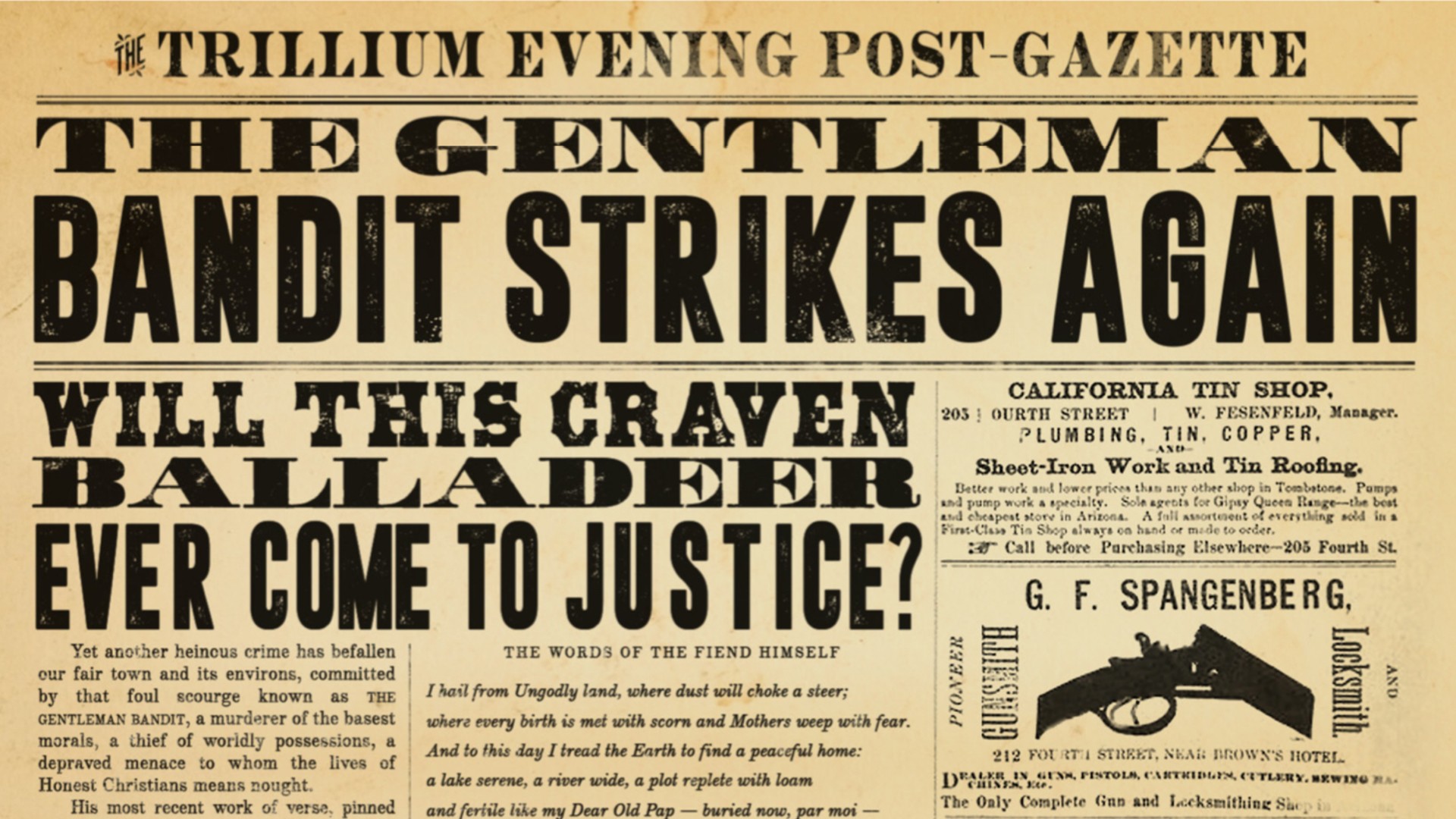
There's something else that poems and games share: a strong association with difficulty and inaccessibility. Whether information technology's right or non, appreciating games and poems is wide felt to depend upon mastery of obscure tools and conventions: arcane button combos and knowledge of genre-standard mechanics on the one hand, the intricacies of metre and rhyme happening the unusual. This is a perception writer and designer Allison Arth tries to address in her Western Cantos verse games, which you can find on Itch.io. The first of these, Gentleman Bandit, casts you as a dashing main road robber writing 13-line poems for those tailor cut down aside your pistol. Lines are written by drawing from a deck of playing cards to determine a motif and subject matter. The Eight of diamonds, for instance, gives you "Exemption" and the question "Where are you loss?" If you want to a greater extent complexity, you can also roll dice to select words from a vocab list, attempt to apply a rhyme scheme or score the resulting poem same a salamander turn over.
IT's a melancholic exercise, influenced by the desolate opposed-Westerns of Cormac Mary McCarthy. But it's also an attempt to make the writing of poetry less fearsome and more, cured, playful. "In its myriad forms, poetry can constitute daunting!" Arth says. "Recitation it, composition IT, talk most it. So I treasured to give the great unwashe a situated of tools to write and share poetry without the baggage of a blank Page OR having to boast the badge of a 'poet'. Layering roleplaying game mechanics over the process of writing a poem felt perfect – it offered a character-impelled entry point for folks WHO might be trepidatious about penning a poem generally, and gave them guidelines and guardrails to help them through the work." Later Western Cantos games expand upon on these cooperative mechanics – virtually fancifully of all, Moonblind takes the form of a dreamy conversation between a rider and their steed. "Gameplay and, away extension, writing the poems becomes less directed, opening many space for player interpretation and wing-stretching, as we say."
Unavailability isn't just a question of tools surgery skill, of course. The video game industry and poetry publication share a chronic lack of diversity – anybody not white, manlike, straight, able-bodied and middle-course of instruction English hawthorn struggle to feel at home. "I grew up in a very small village on the outskirts of Dublin," writer and narrative designer Charlene Putney tells us. "And there was always [this sense that] poesy, theatre, opera, ballet – these things wear't belong to people suchlike the States." Information technology wasn't till her New 20s that Putney – whose credits admit Divinity: Original Sin 2 and Baldur's Gate 3 – became interested graphical poetry herself, after rediscovering literature through the lens of Dublin's experimental fiction scene. "That's when I real got worked up and started to find like this is a place for me, because IT had no pretense, and no big academician language. It was alike: you can suffice whatever you want. You can put a word Here, you can put a Scripture there, you can do stuff that doesn't have a word for it, you can social organisation things in any way you like."
Putney's poetic projects – many created with her partner, Broken Rules co-founder Martin Pichlmair – run the gamut from text generators such A Twitter bot @haikookies to fragmentary self-reflections that shaped her contributions to Larian's RPGs. In a graveyard near Divinity fudge: Original Goof 2's town of Driftwood you'll meet an eagle, Featherfall, that is devouring the corpse of its previous master. The creature's dialogue draws on lines Putney wrote while undergoing treatment for a serious kidney infection. "[I was] writing each these really intuitive, monstrous thoughts about the decaying body and entropy, and taking the pieces that were palatable to share with another manlike organism, and making that into this dead unusual eagle, feeding his dead master in a graveyard."
A trifle less traumatically, Putney once had to compose about 80 poems in just two weeks as rewards for DOS2's Kickstarter backers, each with a different theme. "I basically made a construction, and then wrote that poem over and again. [There were some] insane themes, merely the most ludicrous thing you can imagine anyone typewriting. Like, The Unlikely Level Of This Game, and it's any really obscure RPG from the '80s. Or A Verse form For My Cat, Who Has Been With Me Through Fat And Thin, or The Advantage Of Boobs Finished Booty, or Taking The Redness Pill."

"But where Rock, Star, Magnetic north rediscovers British Romanticism and Edo-period haiku through and through the eyes of "gentle-hearted Trevor", Keeling's game augurs a world in which video game entities themselves leave poems about deity, loss and hope."
If poetry and games buttocks appear forbidding to anybody not steeped in their nuances, Putney suggests that what defines them both is an ethos of involvement, of communion and co-creating a space with the author – even when impermanent with 'static' text. "There's something about getting into the language, getting into the structure, entering into the world of the poem... That's one of the things where games and poems have crossover – you're an accomplice OR collaborator." She's investigating this idea in her upcoming game with Pichlmair, Sulphuric acid, a go of digital interpersonal chemistry remindful of Thomas Ligotti's horror stories, in which you rearrange word mosaics to dig deeper into a "bureaucratic nightmare". "It's like a tale poem," she explains, "only frame into a social system that the player has to puzzle over and piece together."
Putney's sense of poems and games as things to "suffer into" and share resonates with the work of Oma Keeling, founder of Afterglow Games, who summarises their approach as "basically just to make a place and put things in it for someone to come over". Ranging from Bitsy poems to Unity- based "ambient experiences", Keeling's games are pained and passionate, but also witty and adventurous. On one hand in that respect's Res publica: Sepultur, a series of reflections on the death of the Duke Of Edinburgh and Britain's imperial legacy, read by dragging a cursor down pixel photographs of a necropoli. On the other, Manimal Mossing: Moss Variant, a Bitsy game well-nig, yes, gathering moss.
Keeling doesn't get out hard lines around poetry or games. "I don't truly work with a definition of poetry," they sound out. "It's kind of like the old saying or so pornography – you know it when you see it." But they do attentiveness poetry as "intrinsically tied to counterculture and opposed-authoritarianism". If thinking of poems as games makes the world of poetry more than welcoming, as Arth suggests, then thinking of games as poems is an chance to challenge certain top-toss off definitions of 'the TV game' – in particular, the expectation of a reactionary hero narrative mobilised by conquest, with anything not coming together that description dismissed as pretentious Beaver State 'casual' or just plain 'weird'.
Poetry, Keeling suggests, is more able to shuck off such domineering expectations because genre language embraces ambiguity, freedom of reference and creative mishandling of conventions. As Keeling puts it, poetry is "language as a form of resistance [...] because it's using lyric to express something that natural forms of conversation, sentence structures, do it hard to say". Rather than adhering stiffly to labels, it's a agency of making connections, "of playing with things that rhyme, non necessarily in the linguistic sense – just things that fit artistically".
Keeling's most ambitious and eerie work is Alabaster Doughnut Farm, a shortly 3D spirited in which you rove a rusting facility, thousands of years from now, recitation back what look to live the inalterable thoughts of a long-vanished supervisor AI: "I AM Successful INTO A LIQUID / AND THINKING DISTANCES ITSELF / AT THE EDGE OF THE Drag". The project recalls Calum Rodger's tour of GTAV's mountains. With its eerie, natural object stacks of inedible baked goods, IT too seems preoccupied by what it means for a virtual object to lack a function.
But where Rock, Star, North rediscovers British Romanticism and Edo-period haiku through the eyes of "gentle-hearted Trevor", Keeling's bet on augurs a world in which video game entities themselves leave poems about divinity fudge, going and desire. It's a potent portrait of cardinal artforms meeting in the wasteland – all with its cultural baggage, each in a position to study from the another, their future together a stimulating mystery. "I think out what keeps me going back to games and poetry is that there's still so many different things I want to dress, but I assume't know how," Haigh says. "And trying to find out is a unswerving draw for me."
This feature first appeared in issue #353 of Adjoin Magazine . For more good articles like this same, go over all of Edge's subscription offers at Magazines Direct .

Source: https://www.gamesradar.com/from-wordsworth-to-gta-5-exploring-the-unexpected-intersections-between-video-games-and-poetry/
Posted by: calhounfoolity.blogspot.com
0 Response to "From Wordsworth to GTA 5: Exploring the unexpected intersections between video games and poetry - calhounfoolity"
Post a Comment